In the world of mezcal, agave is not merely an ingredient—it is the soul, the voice, and the very essence of terroir captured in living form. Each species tells a story written in thorns and sugar, shaped by altitude and time, and translated into liquid poetry by the hands of master mezcaleros. Understanding agave is understanding mezcal itself, for no spirit is more intimately connected to its botanical source than this ancient elixir of Mexico.
The Sacred Plant: Agave’s Journey Through Time
Before diving into individual varieties, it’s essential to understand agave’s profound role in Mesoamerican culture. For over 9,000 years, indigenous peoples have revered these remarkable plants as gifts from the gods. The Aztecs believed agave was born from the sacrifice of the goddess Mayahuel, whose body became the first agave plant, her 400 breasts transforming into the thorny leaves that protect the plant’s sweet heart.
This mythological foundation reflects a deeper truth: agave represents patience, sacrifice, and transformation. Unlike annual crops that reward farmers with yearly harvests, agave demands decades of faith. A single plant may grow for 8 to 30 years before reaching maturity, converting sunlight and sparse rainfall into concentrated sugars through a process that seems almost alchemical in its efficiency.
The plant’s biology is uniquely adapted to Mexico’s challenging landscapes. Agave uses Crassulacean Acid Metabolism (CAM) photosynthesis, opening its stomata only at night to minimize water loss while still capturing carbon dioxide. This adaptation allows agave to thrive in arid conditions where other crops would perish, making it perfectly suited to the volcanic soils and mountain slopes of Oaxaca where the finest mezcals originate.
The lifecycle itself tells a story of extraordinary patience and dramatic culmination. For most of its life, an agave plant appears static—growing imperceptibly, accumulating sugars, waiting for the perfect moment to flower. Then, in a spectacular finale, it sends up a towering quiote (flower stalk) that can reach 30 feet in height, exhausting all its stored energy in a single reproductive effort before dying, leaving behind seeds and offspring to continue the cycle.
Espadín: The Noble Foundation
Agave angustifolia, known throughout Oaxaca as Espadín, serves as mezcal’s foundation variety, comprising roughly 85% of all mezcal production. Yet calling Espadín “common” would be like calling Mozart’s compositions “standard”—popularity doesn’t diminish excellence, it confirms it.
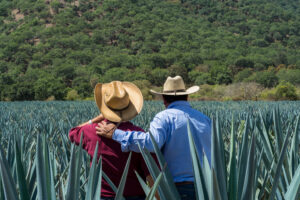
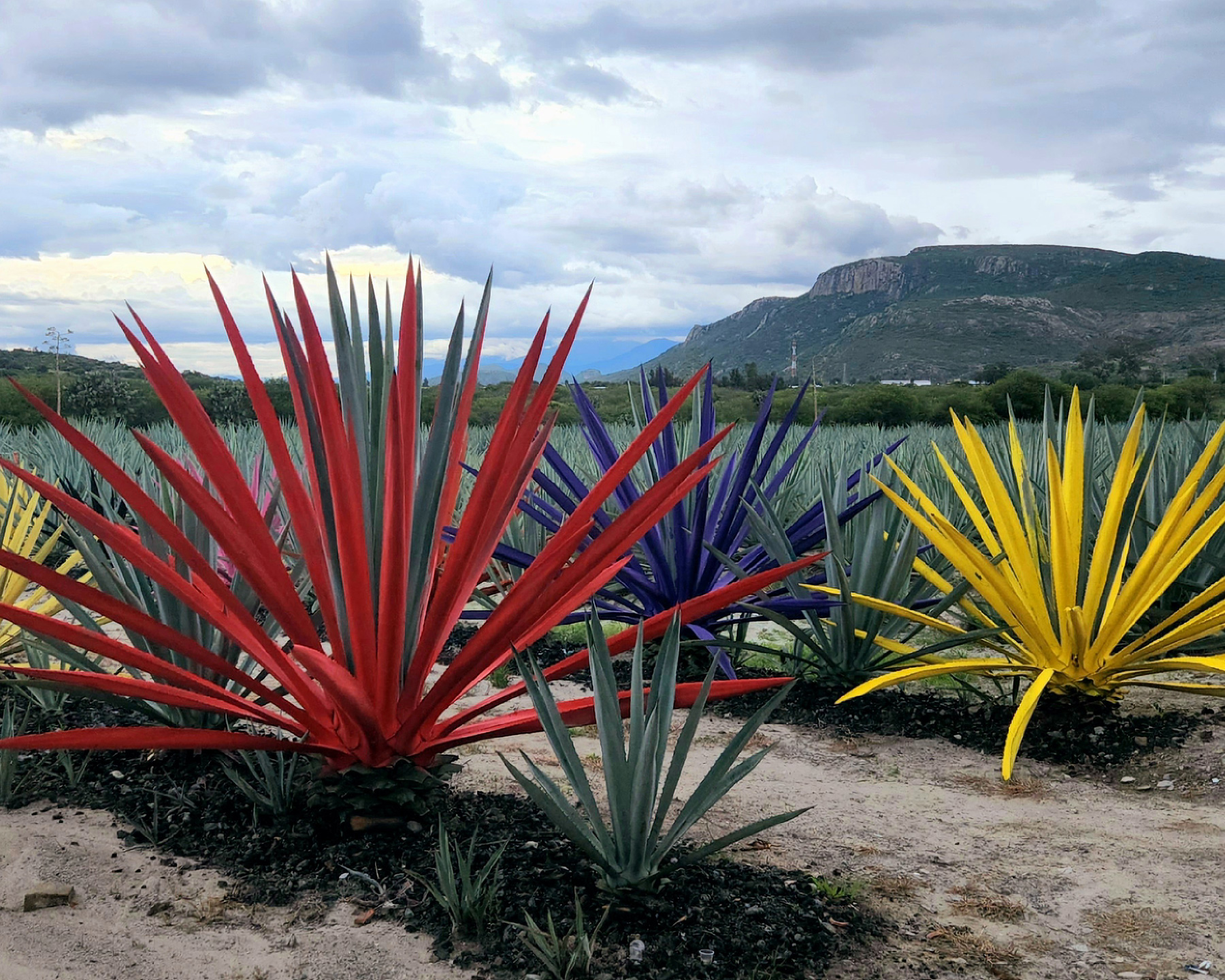
Espadín’s dominance stems from its remarkable balance of reliability and complexity. With a maturation period of 6-8 years, it offers reasonable return on investment for mezcaleros while developing sufficient complexity to create exceptional spirits. The plants typically reach 4-5 feet in height with distinctive blue-green leaves that form perfect geometric rosettes, creating some of the most photogenic agave fields in Mexico.
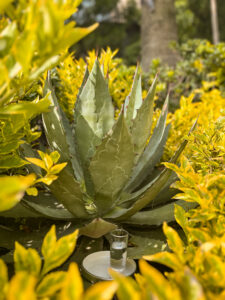
The variety’s visual characteristics provide immediate identification cues for experienced observers. Espadín leaves display a distinctive blue-green coloration with pronounced marginal teeth that follow regular spacing patterns. The leaf tips terminate in sharp, dark spines, while the overall plant structure maintains symmetrical proportions that reflect healthy development and optimal growing conditions.
Traditional pit-roasting brings out Espadín’s inherent smokiness while highlighting underlying notes of cooked agave, mineral earth, and delicate spice. Master mezcaleros describe working with Espadín as conducting a familiar symphony—the notes are well-known, but infinite variations remain possible through subtle adjustments in technique, timing, and terroir interpretation.
Climate and soil significantly influence Espadín’s character, creating regional variations that experienced tasters learn to identify and appreciate. High-altitude plantings above 5,000 feet develop more concentrated flavors and higher acidity due to temperature extremes and intense solar radiation. Valley-floor agaves enjoy more consistent water and temperature conditions, producing spirits with fuller body and softer, more integrated characteristics.
Victorioso’s Espadín exemplifies the variety’s potential when treated with proper respect and traditional methods. The agave is harvested only when sugar content peaks, typically measuring 24-26 degrees Brix through field testing with traditional methods supplemented by modern analysis. Each piña is hand-selected for optimal ripeness, rejecting plants that show signs of stress, disease, or premature flowering that might compromise final quality.
Tobalá: The King of Agaves
In the pantheon of agave varieties, Agave potatorum—known reverently as Tobalá—reigns supreme. Called “Rey de los Mezcales” (King of Mezcals), Tobalá commands respect from producers and consumers alike for its rarity, complexity, and the extraordinary patience required for its cultivation.
Tobalá’s scarcity begins with its growth pattern. While Espadín can be cultivated in organized fields, Tobalá grows wild in the high forests of Oaxaca’s mountains, typically above 6,000 feet elevation. The plants remain small—rarely exceeding 3 feet in height—but develop incredibly dense, sugar-rich piñas that can weigh 40-60 pounds despite their compact size.
The variety’s extended maturation period of 12-15 years means that Tobalá mezcal represents not just craftsmanship, but decades of faith and patience. The plants grow slowly in challenging mountain environments, developing extraordinary sugar concentration and complex flavor compounds through extended exposure to temperature extremes, limited water availability, and intense solar radiation at high altitude.
The flavor profile of well-made Tobalá mezcal is unlike any other agave spirit. Master tasters describe a complex interplay of floral and fruit notes—white flowers, citrus zest, tropical fruit, and herb garden complexity—layered over the fundamental smokiness that defines mezcal. The mouthfeel is distinctively silky, with persistent minerality and a finish that can evolve for minutes after each sip.
This extraordinary complexity results from Tobalá’s unique chemical composition and the environmental stresses that shape its development. High-altitude growing conditions concentrate sugars while developing complex organic acids, esters, and terpenes that create the variety’s distinctive aromatic profile. The challenging growing environment forces the plant to develop sophisticated chemical defenses that translate into flavor complexity unavailable in easier-growing varieties.
Victorioso’s award-winning Tobalá, which captured Best Mezcal and Best in Show at the 2022 LA Spirits Awards, represents the pinnacle of this variety’s potential. The agave is sourced from a single valley high in the Sierra Madre, where indigenous communities have harvested wild Tobalá sustainably for generations using traditional knowledge that balances immediate needs with long-term conservation.
The production process for Tobalá requires adjusted techniques that honor the variety’s special nature. The smaller piñas cook more quickly than Espadín, requiring careful temperature management to prevent scorching while ensuring complete caramelization of sugars. Fermentation proceeds more slowly due to Tobalá’s complex sugar profile, often taking 10-14 days compared to Espadín’s typical 7-10 day cycle.
Cuishe: The Survivor’s Spirit
Agave karwinskii, known locally as Cuishe (pronounced KWEE-shay), embodies resilience and adaptation in plant form. This remarkable variety thrives in some of Oaxaca’s most challenging terrain—rocky hillsides, exposed ridges, and areas where other agaves struggle to survive. The resulting mezcal carries this hardy character, offering bold, mineral-driven flavors that speak of stone and struggle.
Cuishe’s distinctive appearance sets it apart immediately from other agave varieties. The plants grow tall and narrow, often reaching 8-10 feet in height with a relatively slender profile that creates distinctive silhouettes against mountain skylines. This vertical growth pattern allows Cuishe to minimize sun exposure while maximizing water collection from limited precipitation.
The leaves display characteristic narrow, elongated proportions with pronounced gray-green to blue-gray coloration that reflects the variety’s adaptation to intense solar radiation and limited water availability. The variety’s challenging growing conditions contribute directly to its distinctive flavor profile, with Cuishe mezcal typically exhibiting pronounced mineral notes—wet stone, limestone, and metallic hints that reflect the rocky soils where the plants grow.
The extended growing period of 10-12 years allows these mineral influences to concentrate while developing the complex organic compounds that create Cuishe’s distinctive character. The harsh growing environment forces the plant to develop sophisticated chemical defenses and stress responses that translate into flavor complexity unavailable in varieties grown under easier conditions.
Victorioso’s Cuishe showcases the variety’s full potential through careful sourcing and traditional production methods adapted to accommodate its unique characteristics. The roasting process for Cuishe requires specific adjustments to accommodate the variety’s dense, fibrous structure. Extended cooking times—often 5-7 days compared to Espadín’s 3-4 days—ensure complete sugar conversion while developing the complex Maillard reactions that contribute to Cuishe’s distinctive flavor profile.
Wild Varieties: The Genetic Treasury
Beyond the well-known cultivated varieties lies a vast treasury of wild agaves, each adapted to specific microclimates and offering unique flavor profiles that expand mezcal’s possibilities. These varieties—collectively known as “Silvestres”—represent mezcal’s genetic diversity and cultural heritage in their purest forms.
Tepeztate (Agave marmorata) grows on cliff faces and steep rocky slopes, developing over 20-25 years into plants of extraordinary character. The variety’s extreme growing conditions produce mezcals with intense mineral complexity and herbaceous notes that some describe as “green” or “vegetal” in the most positive sense. The extended maturation period allows Tepeztate to develop chemical complexity unavailable in faster-growing varieties, creating mezcals with pronounced salinity and distinctive oily mouthfeel.
Arroqueño (Agave americana) produces some of the largest agave piñas, sometimes exceeding 200 pounds when fully mature after 15-20 years of growth. Despite—or perhaps because of—this extended maturation, Arroqueño mezcal tends toward elegant, refined flavors with pronounced fruit notes and silky texture. The variety’s large size allows for extended fermentation periods that develop complex ester profiles reminiscent of aged spirits.
Madre-Cuishe represents a tall-growing variant of the Karwinskii family, developing over 15-18 years into plants that can reach 12 feet in height. The resulting mezcal combines Cuishe’s mineral backbone with additional complexity from extended maturation, often exhibiting leather and tobacco notes that appeal to spirits connoisseurs familiar with aged whiskies or cognacs.
Coyote (Agave lyobaa) grows wild in Oaxaca’s southeastern regions, producing small quantities of exceptionally complex mezcal after 18-20 years of maturation. The variety’s extended growing period allows development of unique flavor compounds that create mezcals with pronounced floral notes balanced by earthy, mushroom-like undertones that reflect the forest environments where the plants grow.
Terroir: The Language of Place
Understanding agave varieties requires appreciating how terroir—the complete natural environment including soil, climate, altitude, and ecosystem—shapes each plant’s development and ultimate flavor potential. Mexican terroir offers extraordinary diversity within relatively small geographic areas, creating microzones where identical varieties can produce dramatically different mezcals.
Altitude profoundly influences agave development through multiple environmental factors. High-altitude plantings above 6,000 feet experience greater temperature variation between day and night, intense UV radiation, and often reduced precipitation. These stresses concentrate sugars and develop more complex acid profiles, typically resulting in mezcals with bright acidity and pronounced mineral notes.
Valley-floor agaves enjoy more consistent temperatures and water availability, producing spirits with fuller body and softer, more integrated flavors. The reduced environmental stress allows plants to develop larger size and higher sugar content, often resulting in higher yields but potentially less flavor intensity than high-altitude alternatives.
Soil composition directly affects flavor development through nutrient availability, drainage characteristics, and mineral content that plants absorb and incorporate into their tissue. Volcanic soils rich in minerals produce agaves with pronounced earthy and mineral notes that appear clearly in finished mezcals, while limestone-based soils contribute calcium and magnesium that enhance fermentation while creating distinctive chalky notes.
Sandy soils promote clean, focused flavors with less mineral interference but potentially less complexity. Good drainage prevents waterlogging while the minimal mineral content allows agave’s inherent character to express without significant terroir modification, creating pure expressions of varietal character.
The Master’s Touch: Production Influences on Variety Expression
While agave variety and terroir provide the foundation, master mezcaleros translate these natural gifts into exceptional spirits through production decisions that can enhance or diminish varietal character. Understanding how traditional techniques interact with different agave varieties reveals the true artistry of mezcal production.
Harvesting timing critically affects varietal expression, with each variety exhibiting unique visual and tactile cues indicating optimal ripeness. Espadín shows subtle leaf color changes and altered growth patterns, while Tobalá develops characteristic density and sugar concentration that experienced harvesters can detect through careful examination. Master mezcaleros develop variety-specific harvesting expertise accumulated over decades of experience.
Roasting techniques must be adjusted for each variety’s characteristics to optimize flavor development while preventing damage to delicate compounds. Dense varieties like Cuishe require extended cooking times to ensure complete sugar conversion, while delicate varieties like Tobalá need careful temperature control to prevent caramelization from overwhelming subtle floral notes.
Wood selection contributes different smoke characteristics that complement or contrast with each variety’s inherent flavors. Oak provides clean, neutral smoke that allows agave character to dominate, while mesquite contributes more aggressive smoky notes that can enhance robust varieties but might overwhelm delicate ones.
Fermentation management varies significantly among varieties based on their sugar composition, fiber content, and chemical complexity. Tobalá’s complex sugars require longer fermentation periods and may benefit from temperature control to preserve delicate aromatics. Wild varieties often exhibit unique fermentation characteristics that require individualized approaches developed through experience with specific plants and growing conditions.
Distillation techniques showcase the mezcalero’s artistry in translating varietal character into finished spirits. Clay pot distillation tends to enhance mineral and earthy notes that complement varieties like Cuishe, while copper stills may better preserve floral notes in delicate varieties like Tobalá. Cut points—determining which portions of the distillation run to include in the final product—require variety-specific expertise to capture optimal flavor profiles.
Each agave variety represents a unique book in mezcal’s living library—stories written in sugar and smoke, edited by time and terroir, and translated by the master mezcalero’s art. Understanding these varieties transforms mezcal appreciation from simple consumption to cultural participation, connecting drinkers to the land, traditions, and communities that create these exceptional spirits.
Victorioso Mezcal’s commitment to showcasing pure varietal character through traditional production methods ensures that each bottle faithfully represents its agave source. Whether experiencing the reliable excellence of Espadín, the regal complexity of Tobalá, the mineral power of Cuishe, or the unique magic of wild varieties, each sip offers connection to centuries of Mexican cultural heritage preserved in liquid form.
¡Salud! to the agaves that give their lives for our pleasure, to the communities that preserve their diversity, and to the master mezcaleros who translate their essence into liquid poetry.